Showing posts with label digital architecture. Show all posts

Friday, May 27, 2011

D, I & E Reflection

A very big thank you to Stephen Barrass. I very much value the intensive delivery mode of the Digital Design technology units where I feel like I can quickly progress by implementing and then expanding upon learning immediately - before it can be forgotten and then require recapping as in other potential delivery modes. As with previous Digital Design units, Design, Interaction & Environment has opened up a whole new world.

I have never before played with electronics or microprocessors, let alone felt audacious enough to attempt an interactive installation. Of course with any newly learned skills I will need to keep practicing, and it can sometimes be difficult to find the initiative to do this - however I believe that the rapid progression through this unit will now make it more likely that I have the confidence to attempt a project of complexity sufficient to be inspiring. In fact, if I have time, I would like to set up an interactive installation for the my end of year architecture graduating exhibition, which tends to be well attended and a bit of a party.

A particularly appreciated learning experience I think was the production of an installation, which in many ways was a 'real' project. Group work can be very stimulating, but can in a University situation be more often than in a workplace challenging because of unclear roles, lack of (or competing) leadership and group members who don't pull their weight. Thankfully this unit, as a whole of class group project led and facilitated by Stephen, proved to be very productive, and group members who had diverse backgrounds were able to contribute in different ways.

The best bit of the realness of this project was that Stephen left in all the messy bits: we were able to develop a design direction collectively, which is not the easiest processes; we had to shop for the components and materials, which were not always available meaning that we had to adapt the design; we had to investigate and learn new fabrication technologies; and ultimately we ran out of time to finish within the intensive class time! All wonderful lessons in production.

So through this unit I learnt some technical skills like constructing simple electronic circuits and drawing circuit diagrams, and working with various potentiometers and a microprocessor. I also gained great confidence in the adaptability of my programming, particularly in learning Arduino code, which is slightly different to Processing, and in figuring out how to make a library when I was stuck trying to implement classes.

More importantly perhaps were considerations of pertinent content, meaningful interaction, and legible interfaces and environmental responses in the design of installations. Although we were only able to include in our project some of these design and theory ideas, and perhaps in a fairly limited way, I found the class discussion on background readings and research for project proposals most engaging and worthy of expansion in future classes.

I am looking forward to continuing to work on our installation over the next couple of months. I hope that it can still be somewhat collectively curatable - that is I think that more than one person will be able to fit on the tiles at the same time and so suggest that a focus should be interaction between responses to multiple footfalls.

The theme of exploring self organisation is also something that I have had an ongoing interest in. I like very much the tactility of seeing and interacting with self organising systems that are rendered outside of the computer screen.

R&Sie(n) 'I've heard about'

R&Sie(n) 'I've heard about'
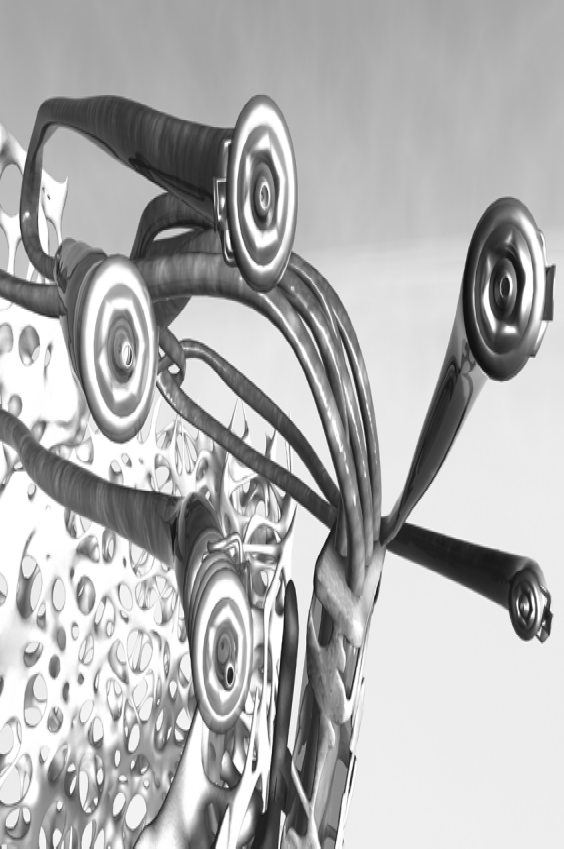
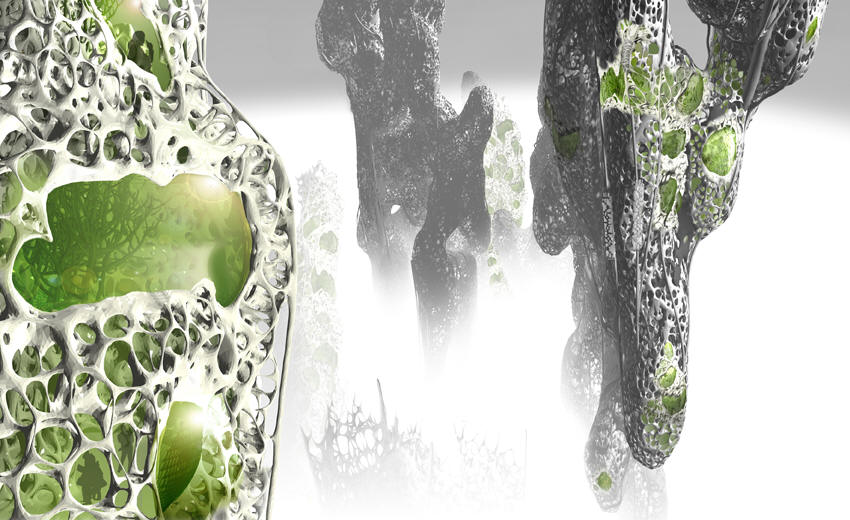
Taking research at the intersection of self organising systems, architecture and physical computing to a conceptual extreme are R&Sie(n), whose project 'I've heard about' for example envisions an architecture not centrally controlled, self constructed and continually grown and adapted, by landscape secreting 'Viabs' which respond to local conditions including chemical emissions data of it's human inhabitants. This biostructure no longer seems quite so futuristic.

Friday, April 1, 2011

Design, Interaction & Environment

This is the first of a series of blogs for the unit Design, Interaction & Environment which can be followed with the tag 8200 (the unit number). This unit is being led by Stephen Barrass who has many exciting projects in this field and a particular focus on data sonification (making sound from data). We will be using Arduino and experimenting with inputs from environmental sensors, human interfaces and other data sources, and outputs that have a physical manifestation in the environment such as light, sound and movement. Ultimately as a class we will make an installation for the foyer of Building 9 at the University of Canberra. It is nice to be reassured by Tom Igoe that there is merit in doing another iteration of a theme already well established.

My initial interests in interactivity and environmental awareness stem from a cursory look at some of the following projects as I have come across them, with little understanding of the systems behind them or in general what physical computing is about.


Automation - are buildings too complex for users?

The first and obvious architectural application of physical computing is automation of building systems in response to environmental stimuli - for example adjusting the position of shading or photo voltaic panels based on sun position, turning on/off lights based on occupancy and levels of daylight, adjusting ventilation (opening/closing windows) and turning on/off mechanical heating and cooling systems based on temperature. These computerised controls are broadly referred to as Building Management Systems (BMS) and are often largely unnoticed by building occupants.

The mantra with sustainable buildings, particularly solar passive houses, is that they need active users - windows, curtains etc must be opened/closed at correct times and if they are not, the building can perform significantly worse than a conventional building! Automated systems are common in new commercial buildings and perhaps for this reason could also be important in houses.

A visually expressive example of an automated system is Jean Nouvel's Arab World Institute brise soleil which is a beautiful array of 240 motorised apertures evoking traditional Islamic screens.

Arab World Institute, Paris, architect Jean Nouvel, 1981-87 - the brise soleil seen from interior
A more contemporary example on a larger scale is LAVA's solar umbrellas for the plaza in their winning Masdar City Center design. The solar umbrellas are modeled on flowers and fold up at night.

Masdar City Center design competition winning entry, LAVA, 2009 - solar umbrellas in public plaza


Making the intangible tangible

The next projects are interactive art installations. I, like Vanessa Wang, keep coming back to Scott Snibbe's Boundary Functions. I first saw this project when I was experimenting with abstracted Voronoi diagrams to arrange program and divide space in a second year architecture studio led by Iain Maxwell.

Boundary Functions, Scott Snibbe, 1998
Boundary Functions uses a Voronoi diagram to project personal space as cells with boundaries halfway between people and their neighbours - that is that all space within in the cell is closer to the owner than their neighbour. The cell size, shape and boundary change dynamically as people move and population densities vary. The system uses an overhead camera and projector to track people and display the diagram. I like this project because it makes an important environmental condition that is usually experienced by feeling tangible in a visual way that allows it to be better understood. Personal space is not often thought about critically and this installation makes apparent the contextual nature of it - that is that personal space is not fixed and can only exist in relationship to your neighbours. Snibbe further comments that as the installation can only exist with more than one person and in a physical space, it is a reversal of the usual lonely self-reflection of virtual reality or frustration of virtual communities.

On questioning personal space, this time in relation to machine (can you be intimate with a machine?), I also very much liked a student project that Bert Bongers showed at the 2007 AASA Conference. It was an installation (creature) that had long stick-like limbs and picking up movement or proximity would lean over to be near you (is it leering at me or is friendly? is it invading my personal space? is it going to touch me?!)

Tuned Stair, Daniel Hirschmann 2006, Fabrica exhibition, Centre Pompidou
Another favourite is Daniel Hirschmann's Tuned Stairs - part of the 2006 Fabrica exhibition at the Centre Pompidou. These piano stairs have pressure sensitive pads (mat switches) installed on stairs that (through an Arduino microprocessor!) each trigger a different note. This is a very simple and beautiful  way to make legible the different cadences of people as they move through the space - it also encourages people to perform. Grand stairs in theatres particularly, where patrons are dressed up, but all stairs in public places to some extent, are already associated with performance or exhibitionism. The piano stairs are a contemporary interpretation of giving tuned resonances to architectural elements - an idea that has been resolved by Carlo Scarpa as musical steps in the Brion Cemetery and by Vijayanagara temple builders as musical columns that the priests 'play' most famously in the Vittala temple.

Musical Stairs at Brion Cemetery, Carlo Scarpa 1970-72
Vittala Temple, Vijayanagara 15C
The other project in this theme that I really like, again for it's simplicity, is Usman Haque's Sky Ear which is a floating sculpture of helium balloons, electromagnetic sensors and mobile phones. The changing colours of the balloon LEDs make apparent the underlying electromagnetic patterns and the impact of calls and messages to the balloon phones.

Sky Ear, Usman Haque 2004, Greenwich
Dan Hill in his narrative The Street as Platform further elaborates an understanding of digital substrates - layers of data that can be collected, made legible and interacted with.


The beginnings of a physical computing syntax

From reading a couple of background papers presented at the Sketching in Hardware 2010 conference a syntax, or taxonomy even, for interaction design begins to emerge.

Carla Diana talked about a natural user interface, exemplified by the the gestures used to control the iPhone's touch screen. Emphasising appropriate gestures, screen readability and ergonomics, Diana discussed the position of metaphor, abstraction, mapping, feedback, delight and personality in interface design.

Ellen Do elaborated on this theme,  calling for a human centric view of designing interactions for example

  • Hand: touch, press, pick up, hold, squeeze, gesture 
  • Body: sight, sound, sense, sit, stand, walk, sleep, movement pattern
  • Environment: light, space, ambiance, navigation, context aware.

Do describes a responsive architecture as an environment that takes an active role, initiated changes as a result and function of complex or simple computations, but also knows me and the context it is in and establishes a framework of considerations for designing A-E-I-O-U:
  • Activities: What are they doing?
  • Environments: Where is it taking place? (eg location, noise, lighting, all the senses)
  • Interactions: With whom are they interfacing? (eg talking, seeing, collaborating)
  • Objects: What are they using? (eg chair, projector, keyboard)
  • User: Who are they? (eg group, individuals, roles, demographic data)


One final project that I want to mention is the interactive white board style hacks for projectors and flat screens using Wii Remotes to track the position of a pen that has an infrared LED. In 2009 Leo Carson and Christine Murray led a group of other MDD students, with support from Mitchell Whitelaw and Gurdev Singh to successfully implement a version in Processing. They ended up setting Boon Jin Goh's Smoothboard, a program that already has more sophisticated features built in, for design crits in the architecture studios. On screen markups that can be recorded as stills or movies finally brings to digital presentations the immediacy and intuition of traditional iterative feedback processes using butter paper. You can see in the video below Gurdev enjoying marking up my project.

Monday, December 13, 2010

Reflections on Generic City

Performance night was successful and a lot of fun (see photos following). Many thanks to Mitchell Whitelaw for organising the project and superb guidance throughout.

Generic City C8 - performance night, photographer Mitchell Whitelaw
Not such a generic audience...
Picnic rug on kerb side?
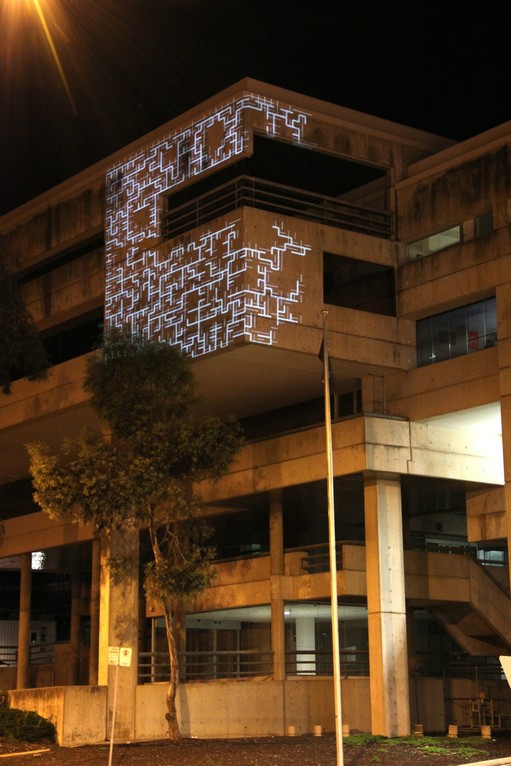
Refining after the dry run, I developed a tool to set, remember and edit where windows are, and so was able to make growth avoid windows. This worked very smoothly (although it was a little cumbersome to edit using arrow keys) and was a great visual improvement on the untidiness of the dry run. 

Also after the dry run, I slowed the growth rate and increased the range of growth speeds, but perhaps could have gone further - I was trying to balance against speed to show at a glance the dynamic and iterative quality. On the night in response to feedback I did in fact slow it down further. Mitchell described the generated cities as having an elusive quality - just as soon as they were fully grown they disappeared, and because you never knew when they were fully grown and therefore about to disappear, it was impossible to photograph! Mitchell's very nice suggestion was to pause before disappearing and then fade in transition. 

This got me thinking about other ways to improve legibility. As each frame many cells can grow and as each cell can have many children or branches, it quickly becomes difficult to follow new growth. Perhaps I could have more tightly controlled growth by keeping track of a cell's age since it last grew and limiting future growth in this way, or by limiting number of children or branching so that growth is more linear - I didnt consider limiting branching previously because I was only thinking about density which I controlled by number of neighbours.

Further it might be interesting to trace pathways through the city or highlight precincts defined for example by blocks serviced by particular streets, blocks adjoining particular public squares or neighborhoods of the same block type. This would assist in reading the structure of the city.

On the performance night it was again abundantly clear that the simplest geometries were the most striking and legible at this scale. Perhaps, against what I wrote previously, this is cause to extend a shape grammar with little variance and highly structured relationships endlessly across the facade. Perhaps a Cameron Offices or other John Andrews skin, or even a skin based on the Nolli Plan of Rome would have been really effective. This is a lesson about misjudgment, a reminder to test often and early.

The most significant difference between Generic City and a potential John Andrews shape grammar is that Generic City has non-deterministic relationships adding an exciting additional layer of complexity - that of allowing emergent orders, simply from interactions between neighbouring cells. Harnessing emergence better simulates organic city growth, accommodating multiple competing forces, and so makes for the beginnings of a potentially powerful analytical or design tool.

One final loose end, I previously suggested making Generic City interactive. I never pursued this because I judged that apart from conditions that changed the speed of growth or events that terminated a city and began a new one it would be difficult to make the interactivity legible - what condition could legibly control block type for instance? Further any interaction would potentially clash with internal growth imperatives, making the underlying system more difficult to read.

This project is principally concerned with exploring a generative system and grounding it by the interpretive content: tectonic dressing of structure, articulating surface and fenestration; generative system as emphasis of the architecture as system; networked city precinct to reveal the seeds for a greater whole contained within a single building; an iterative production to imply the conflation of past, future and alternate realities. It is critical that the system is legible.

Generic City C8 - performance night, photographer Mitchell Whitelaw

Sunday, October 24, 2010

Ocean Network - a model for contemporary collaborative praxis?

The following is a short survey or map of a scene - the Ocean network - that was an assignment for the unit 8197 Contexts in Digital Design.

Ocean, currently OCEAN Design Research Network and oceanD, but best known by the former Ocean North, is an interdisciplinary research network of young academics and research based practices that are mostly focussed on architecture.

Collaborative projects are promoted to such an extent that the primary manifesto of Ocean becomes that the research network, beyond simply disseminating ideas, has a creative potential as a flexible forum for production that is much greater than traditional practices or academic silos. The pertinence of this suggested path for contemporary practice is evidenced by the interest in collaboration that is now beginning to filter into commercial, mainstream, architectural practice under the banner of integrated design that is made possible with  BIM.

In terms of setting an agenda, Ocean's position in the architectural avant garde recalls that of CIAM and Team 10. Ocean describe the design paradigm that they promote as post-conflict, heterogeneous, stimulating, performative, context-specific, and socially and environmentally sustainable. A research area of particular priority is the application of computation and biomimetics, bionics and biomechanics to performance oriented design of systems and materials, which builds on the legacy of Antoni Gaudi and Frei Otto.

Ocean's mode of practice is dominated by outputs that favour the experimental such as design competition, publication, exhibition, installation, pavilion and studio projects in an academic environment, characterised by iterative incremental development, testing in different contexts and schools, and a desire towards exploration and dissemination - although some members also spend significant time working in relatively traditional teaching and practice contexts.

New Czech National Library design competition 2006

Barley 2 sound installation 2008
Formation

Ocean is centred around the Architecture Association (AA) in London where it was formed as an experimental think tank by graduate students Michael Hensel, Ulrich Konigs, Tom Verebes and Bostjan Vuga in 1994. Verebes and Hensel went on to be lead teachers and researchers at the AA graduate school, with Verebes becoming a head of the the Design Research Lab (AA DRL) and Hensel being a leader in the development of the Emergent Technologies and Design programme (AA EmTech).

The 'official' Ocean membership is somewhat fluid and the broader scene is a dynamic network of current and former members, groups and collaborators. Many in the Ocean network loosely organise in geographic groups described as nodes - current/previous nodes include: London; Helsinki, Oslo, Rome, Frankfurt and Cologne which practiced together as Ocean North; Boston; and Sydney.

Hensel has been the most prominent in publicising Ocean, articulating it's research priorities and formalising the network, and his writing, often in collaboration with others, has been prolific. When Ocean was restructured in 2008, Hensel was elected founding chair of the Ocean Design Research Network, which was registered as an association in Norway.

Significant Groups, Members and Collaborators

Significant members and collaborators
  • Michael Hensel (London, Cologne, Istanbul, Oslo) - studied at the AA and previously led the AA EmTech, teaches at AHO, on editorial board of AD and the Journal for Bionic Engineering (JBE), research interests in biomimetics and performative design
  • Ulrich Konigs (Cologne) - studied at the AA, teaches at the University of Wuppertal, practice is Koenigs,
  • Tom Verebes (London) - led the the AA DRL, practice is now Ocean UK / oceanD
  • Bostjan Vuga (Ljubljana) - studied at the AA, practice is Sadar Vuga, 
  • Achim Menges (London, Frankfurt, Stuttgart) - leads the ICD at Stuttgart University, teaches in (and previously led) the AA EmTech and teaches at Harvard, research interests in biomimetic design and fabrication, see Evolutionary Strategies 
  • Michael Weinstock (London) - leads the AA EmTech, research interests in biomimetics and materials
  • Jeffrey Turko (London) - studied and teaches at the AA, practice is NEKTON
  • Paul Hladik (London, Prague) - studied in the AA EmTech and at CTU, works with ArupSport, founder of Nolimat group
  • Kivi Sotamaa (Helsinki) - studied at TaiK and the Royal College of Art, leads the Digital Design Laboratory at the TaiK Design Factory, teaches at UCLA, practice is Sotamaa
  • Tuuli Sotamaa (Helsinki) - studied and teaches at TaiK, practice is Sotamaa
  • Toni Kauppila (Helsinki) - studied at the Bartlett, teaches at TaiK, practice is ND (see Tatit)
  • Defne Sunguroglu Hensel (Oslo, London, Istanbul) - studied at the AA, teaches at AHO, research interests in materials
  • Birger Sevaldson (Oslo) - teaches at AHO, interests in interior architecture, industrial design and systems thinking
  • Natasha Barrett (Oslo) - composer and sound installation artist, research interest in spatio-musical potentials
  • Steinar Killi (Oslo) - teaches at the AHO
  • Aleksandra Jaeschke and Andrea Di Stefano (Rome) - studied at the AA, practice is AION
  • Robert Efer (Boston) - studied at McGill, teaches at the BAC, practice is Studio Troika / Ocean US 
  • Wade Stevens (Boston) - studied at MIT and Harvard, teaches at the BAC, worked with large firms, now practice is Ocean US
  • Adrian Lahoud (Sydney) - studied at RMIT, teaches at UTS, practice is Asabiyah, research interests in  urban design and politics
  • Anthony Burke (Sydney) - head of the architecture school at UTS, practice is Offshore Studio, research interests in urban design
  • Yasha Grobman (Tel Aviv) - studied at the AA DRL, teaches at Technion, Colman College and Tel Aviv University, research interests in computation and sustainability
  • George Jeronimidis (Reading, London) - honorary member, leads research and teaching on biomimetics, heads BIONIS, teaches at the University of Reading and in the AA EmTech programme
  • Mark Burry (Melbourne) - honorary member, leads the Spatial Information Architecture Laboratory (SIAL) at RMIT, using computation to complete design of Gaudi's Sagrada Famila in Barcelona

Significant groups (nodes):
  • Ocean North was primarily Michael Hensel, Kivi and Tuuli Sotamaa, Achim Menges and Birger Sevaldson, but also variously Defne Sunguroglu Hensel, Toni Kauppila, Aleksandra Jaeschke, Andrea Di Stefano, Steinar Killi and Natasha Barrett amongst others, and practiced as Ocean North from 1998 to 2006.
  • Ocean US is lead by Robert Efer and Wade Stevens.
  • Ocean UK is lead by Tom Verebes
  • Ocean Sydney is lead by Adrian Lahoud, Anthony Burke, Charles Rice and is centred around the architecture school UTS, with collaborators mostly being other teachers and students from the school including David Burns (formerly SO-AD), Chris Bosse (Lava, formerly PTW), Joanne Jakovich, Ben Hewett (also Offshore Studio) and Samantha Spurr. The Vector Guerillas and Post-Traumatic Urbanism  blogs record some of the collaborative project work. 

Current

Ocean Design Research Network and oceanD are separate networks led respectively by Hensel and Sevaldson, and by Verebes, Elfer and Stevens. oceanD are operating much like a traditional practice with offices in London (Ocean UK) and Boston (Ocean US) seeking commercial work. While the Ocean Design Research Network, continuing to be primarily situated in an academic context, has expanded to include a Sydney node centred at UTS (*), yet its website has not been updated for two years and Hensel appears to be maintaining the Performance Oriented Design website instead.

Ocean Design Research Network:
  • (Oslo) Michael Hensel, Defne Sunguroglu Hensel, Birger Sevaldson, Natasha Barrett
  • (London) Daniel Coll i Capdevila, Jeffrey Turko, Mattia Gambardella; (London, Prague) Paul Hladik
  • (Sydney) Adrian Lahoud, Anthony Burke (*), Charles Rice (*)
  • (Tel Aviv) Yasha Grobman
  • Honorary - (Reading, London) George Jeronimidis; (Melbourne) Mark Burry
oceanD:
  • (London) Tom Verebes, Felix Robbins
  • (Boston) Robert Elfer, Kevin Cespedes, Masoud Mahboobullah; (Boston, New York) Wade Stevens

Publications

Hensel is on the editorial board of Architecture Design (AD), which has been used as the primary platform for publishing Ocean's research, and the Journal for Bionic Engineering (JBE).

Seminal publications are:
A number of the individuals maintain websites and blogs (see above). Primary websites are:


    UTS Membrane Masterclass 2008
    AA EmTech Membrane Canopy 2007