Showing posts with label biomimetics. Show all posts

Friday, May 27, 2011

D, I & E Reflection

A very big thank you to Stephen Barrass. I very much value the intensive delivery mode of the Digital Design technology units where I feel like I can quickly progress by implementing and then expanding upon learning immediately - before it can be forgotten and then require recapping as in other potential delivery modes. As with previous Digital Design units, Design, Interaction & Environment has opened up a whole new world.

I have never before played with electronics or microprocessors, let alone felt audacious enough to attempt an interactive installation. Of course with any newly learned skills I will need to keep practicing, and it can sometimes be difficult to find the initiative to do this - however I believe that the rapid progression through this unit will now make it more likely that I have the confidence to attempt a project of complexity sufficient to be inspiring. In fact, if I have time, I would like to set up an interactive installation for the my end of year architecture graduating exhibition, which tends to be well attended and a bit of a party.

A particularly appreciated learning experience I think was the production of an installation, which in many ways was a 'real' project. Group work can be very stimulating, but can in a University situation be more often than in a workplace challenging because of unclear roles, lack of (or competing) leadership and group members who don't pull their weight. Thankfully this unit, as a whole of class group project led and facilitated by Stephen, proved to be very productive, and group members who had diverse backgrounds were able to contribute in different ways.

The best bit of the realness of this project was that Stephen left in all the messy bits: we were able to develop a design direction collectively, which is not the easiest processes; we had to shop for the components and materials, which were not always available meaning that we had to adapt the design; we had to investigate and learn new fabrication technologies; and ultimately we ran out of time to finish within the intensive class time! All wonderful lessons in production.

So through this unit I learnt some technical skills like constructing simple electronic circuits and drawing circuit diagrams, and working with various potentiometers and a microprocessor. I also gained great confidence in the adaptability of my programming, particularly in learning Arduino code, which is slightly different to Processing, and in figuring out how to make a library when I was stuck trying to implement classes.

More importantly perhaps were considerations of pertinent content, meaningful interaction, and legible interfaces and environmental responses in the design of installations. Although we were only able to include in our project some of these design and theory ideas, and perhaps in a fairly limited way, I found the class discussion on background readings and research for project proposals most engaging and worthy of expansion in future classes.

I am looking forward to continuing to work on our installation over the next couple of months. I hope that it can still be somewhat collectively curatable - that is I think that more than one person will be able to fit on the tiles at the same time and so suggest that a focus should be interaction between responses to multiple footfalls.

The theme of exploring self organisation is also something that I have had an ongoing interest in. I like very much the tactility of seeing and interacting with self organising systems that are rendered outside of the computer screen.
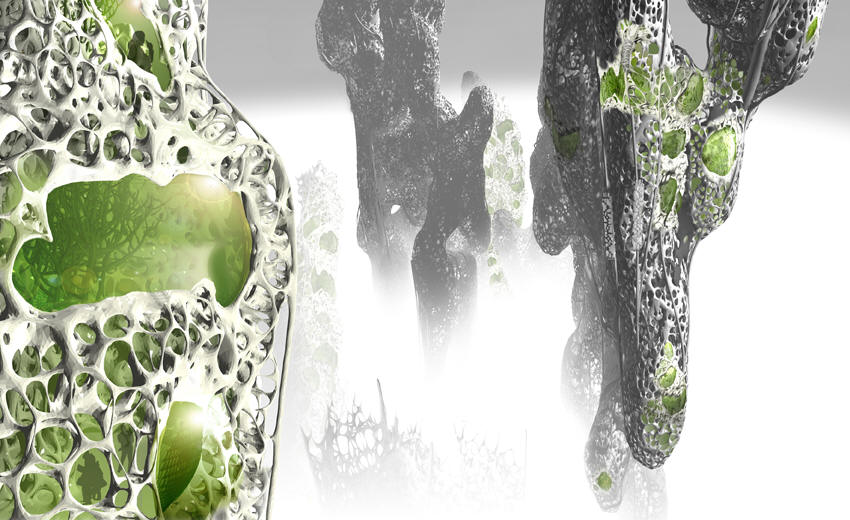
R&Sie(n) 'I've heard about'

R&Sie(n) 'I've heard about'
Taking research at the intersection of self organising systems, architecture and physical computing to a conceptual extreme are R&Sie(n), whose project 'I've heard about' for example envisions an architecture not centrally controlled, self constructed and continually grown and adapted, by landscape secreting 'Viabs' which respond to local conditions including chemical emissions data of it's human inhabitants. This biostructure no longer seems quite so futuristic.

Tuesday, April 26, 2011

Hyperbolic Coral

This post is some long overdue documentation for the Hyperbolic Coral, which was the result of a computational nature study that Kerrin Jefferis and I did for the unit 8195 Generative Design and was exhibited last November as part of Cultural Interfaces at CraftACT.

The idea of a computational nature study was to develop a generative system based on an understanding of the logic of a natural system, a practice that has been gaining momentum in architecture. In nature there are many examples of hyperbolic forms including those found in kelps, anemones and corals as well as sea slugs and leaves from lettuce to holly. Hyperbolic geometry is non-Euclidean, having at least two lines parallel to any line l through any point A not on l, and is characterised by maximised, exponentially increasing, surface area and boundary edge length. Coral needs maximised surface to collect nutrients from the sea, while sea slugs use it to propel themselves with minimal effort.

The starting point of the project was an inspiring TED lecture by Margaret Wertheim about her Crotchet Coral Reef project with the Institute for Figuring which has seen satellite reefs crocheted all around the world. We fairly literally made a digital version of this system in Processing using the Traer Physics simulation library.


Crotchet Coral and Anemone Garden with Sea Slug, Marianne Midelburg (photo: Alyssa Gorelick)

Crotchet was first used to model hyperbolic forms by Daina Taimina in 1997. Other mathematics had been struggling to model hyperbolic forms for decades. The genius of the approach is that it doesn't require a complex mathematical description of the entire form - just a simple algorithm describing the relationship between one row of stitches and the next. Normally in crotchet new rows have one stitch for each stitch in the previous row. However with hyperbolic crotchet an extra stitch is added for every nth stitch in the previous row. We have termed this a growth pattern, and conceptually thought about the coral growing from the first row.

To translate the system to Processing we needed two conceptual parts - a constructor to build relationships between stitches and a physics simulator to give material properties allowing the stitches to self optimise their position (ruffle).

Essentially the stitches are replaced with particles connected by springs. The particles are free to move and the springs can be compressed or stretched but have a rest length that they try to reach. The system comes to equilibrium when as many springs are as close as possible to their rest length - a condition that requires a resolved hyperbolic form.

The constructor takes a ring with x particles and grows i rings based on a growth pattern (eg {1,2} specifies an extra particle for every 2nd particle in the previous ring). The particles are connected by springs to the immediately adjacent particles in the ring and to the parent particle in the previous ring.

Hyperbolic Coral - {2,3} growth pattern, 4 particles in first, 5 rings 

Hyperbolic Coral - {3,3} growth pattern, 4 particles in first, 5 rings

Particle physics simulation is computationally resource intensive limiting the number of particles that a model can contain. A coarse polygon mesh makes a perceptually faceted model. We smoothed our model, approximating the form of a model with more rings of particles by exponentially increasing the rest length of springs between outer rings.

A repellent force between all particles was introduced to assist the form finding - where as fabrics have a certain stiffness this system could bend back on itself 'impossibly' and get tangled up. Additional springs could be added as cross-bracing to further reduce bending.

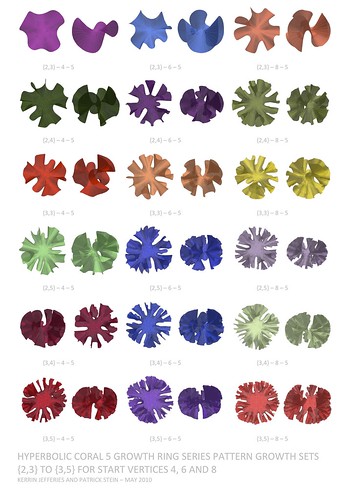
To ensure a stable system the strengths of all the forces including drag and spring stiffness and damping need to be continually tweaked for each change in the number and density of particles (controlled with variables such as number of particles in the first ring, growth pattern, number of rings and spring rest lengths). This constant micro management of the system doest allow a single stable profile to be set such that a 'plug and play' generic hyperbolic form generator can be sent out into the world. The version on Open Processing is stable for the range of: 5 rings; growth patterns {2,3} to {3,5}; and 4, 6 or 8 particles in the first ring.

Hyperbolic Coral - the full set of possible models from the Open Processing version
We had a go at fabricating a model using Shapeways nylon selective laser sintering (SLS). A polygon mesh was exported from Processing to Rhino where it was cleaned up, thickened into a volume 1.5mm thick and saved as an STL file for Shapeways.

Hyperbolic Coral - nylon SLS
Coral hanging out at Cultural Interfaces with Mitchell Whitelaw's Weather Bracelet and Measuring Cup
(photo: Mitchell Whitelaw)
Once released into the wild some renderings of the coral popped up at architectural scale visualising the potential for a giant pavilion! In terms of architectural application I mostly imagine continuing the exploration of self organising/optimising systems and training these for architectural purpose. A very beautiful realised installation is Chris Bosse's Green Void, which is a hyperbolic form with a different generating strategy. Of course one can also imagine functional reasons for wanting hyperbolic forms given they have exponential surface and boundary.

Hyperbolic Coral  in the wild (rendering: Dominik Raskin)
Hyperbolic Coral in the wild (rendering: Dominik Raskin)
In the future it would be nice to train the coral generator to do more tricks including accommodating different starting geometry and multiple pieces that can be stitched together. The Crotchet Coral Reef project encourages participants to introduce mutations into their algorithms to create endless variations (evolutions) that are not mathematically pure, which I suspect is a rich strategy for future exploration.

Sunday, October 24, 2010

Ocean Network - a model for contemporary collaborative praxis?

The following is a short survey or map of a scene - the Ocean network - that was an assignment for the unit 8197 Contexts in Digital Design.

Ocean, currently OCEAN Design Research Network and oceanD, but best known by the former Ocean North, is an interdisciplinary research network of young academics and research based practices that are mostly focussed on architecture.

Collaborative projects are promoted to such an extent that the primary manifesto of Ocean becomes that the research network, beyond simply disseminating ideas, has a creative potential as a flexible forum for production that is much greater than traditional practices or academic silos. The pertinence of this suggested path for contemporary practice is evidenced by the interest in collaboration that is now beginning to filter into commercial, mainstream, architectural practice under the banner of integrated design that is made possible with  BIM.

In terms of setting an agenda, Ocean's position in the architectural avant garde recalls that of CIAM and Team 10. Ocean describe the design paradigm that they promote as post-conflict, heterogeneous, stimulating, performative, context-specific, and socially and environmentally sustainable. A research area of particular priority is the application of computation and biomimetics, bionics and biomechanics to performance oriented design of systems and materials, which builds on the legacy of Antoni Gaudi and Frei Otto.

Ocean's mode of practice is dominated by outputs that favour the experimental such as design competition, publication, exhibition, installation, pavilion and studio projects in an academic environment, characterised by iterative incremental development, testing in different contexts and schools, and a desire towards exploration and dissemination - although some members also spend significant time working in relatively traditional teaching and practice contexts.

New Czech National Library design competition 2006

Barley 2 sound installation 2008
Formation

Ocean is centred around the Architecture Association (AA) in London where it was formed as an experimental think tank by graduate students Michael Hensel, Ulrich Konigs, Tom Verebes and Bostjan Vuga in 1994. Verebes and Hensel went on to be lead teachers and researchers at the AA graduate school, with Verebes becoming a head of the the Design Research Lab (AA DRL) and Hensel being a leader in the development of the Emergent Technologies and Design programme (AA EmTech).

The 'official' Ocean membership is somewhat fluid and the broader scene is a dynamic network of current and former members, groups and collaborators. Many in the Ocean network loosely organise in geographic groups described as nodes - current/previous nodes include: London; Helsinki, Oslo, Rome, Frankfurt and Cologne which practiced together as Ocean North; Boston; and Sydney.

Hensel has been the most prominent in publicising Ocean, articulating it's research priorities and formalising the network, and his writing, often in collaboration with others, has been prolific. When Ocean was restructured in 2008, Hensel was elected founding chair of the Ocean Design Research Network, which was registered as an association in Norway.

Significant Groups, Members and Collaborators

Significant members and collaborators
  • Michael Hensel (London, Cologne, Istanbul, Oslo) - studied at the AA and previously led the AA EmTech, teaches at AHO, on editorial board of AD and the Journal for Bionic Engineering (JBE), research interests in biomimetics and performative design
  • Ulrich Konigs (Cologne) - studied at the AA, teaches at the University of Wuppertal, practice is Koenigs,
  • Tom Verebes (London) - led the the AA DRL, practice is now Ocean UK / oceanD
  • Bostjan Vuga (Ljubljana) - studied at the AA, practice is Sadar Vuga, 
  • Achim Menges (London, Frankfurt, Stuttgart) - leads the ICD at Stuttgart University, teaches in (and previously led) the AA EmTech and teaches at Harvard, research interests in biomimetic design and fabrication, see Evolutionary Strategies 
  • Michael Weinstock (London) - leads the AA EmTech, research interests in biomimetics and materials
  • Jeffrey Turko (London) - studied and teaches at the AA, practice is NEKTON
  • Paul Hladik (London, Prague) - studied in the AA EmTech and at CTU, works with ArupSport, founder of Nolimat group
  • Kivi Sotamaa (Helsinki) - studied at TaiK and the Royal College of Art, leads the Digital Design Laboratory at the TaiK Design Factory, teaches at UCLA, practice is Sotamaa
  • Tuuli Sotamaa (Helsinki) - studied and teaches at TaiK, practice is Sotamaa
  • Toni Kauppila (Helsinki) - studied at the Bartlett, teaches at TaiK, practice is ND (see Tatit)
  • Defne Sunguroglu Hensel (Oslo, London, Istanbul) - studied at the AA, teaches at AHO, research interests in materials
  • Birger Sevaldson (Oslo) - teaches at AHO, interests in interior architecture, industrial design and systems thinking
  • Natasha Barrett (Oslo) - composer and sound installation artist, research interest in spatio-musical potentials
  • Steinar Killi (Oslo) - teaches at the AHO
  • Aleksandra Jaeschke and Andrea Di Stefano (Rome) - studied at the AA, practice is AION
  • Robert Efer (Boston) - studied at McGill, teaches at the BAC, practice is Studio Troika / Ocean US 
  • Wade Stevens (Boston) - studied at MIT and Harvard, teaches at the BAC, worked with large firms, now practice is Ocean US
  • Adrian Lahoud (Sydney) - studied at RMIT, teaches at UTS, practice is Asabiyah, research interests in  urban design and politics
  • Anthony Burke (Sydney) - head of the architecture school at UTS, practice is Offshore Studio, research interests in urban design
  • Yasha Grobman (Tel Aviv) - studied at the AA DRL, teaches at Technion, Colman College and Tel Aviv University, research interests in computation and sustainability
  • George Jeronimidis (Reading, London) - honorary member, leads research and teaching on biomimetics, heads BIONIS, teaches at the University of Reading and in the AA EmTech programme
  • Mark Burry (Melbourne) - honorary member, leads the Spatial Information Architecture Laboratory (SIAL) at RMIT, using computation to complete design of Gaudi's Sagrada Famila in Barcelona

Significant groups (nodes):
  • Ocean North was primarily Michael Hensel, Kivi and Tuuli Sotamaa, Achim Menges and Birger Sevaldson, but also variously Defne Sunguroglu Hensel, Toni Kauppila, Aleksandra Jaeschke, Andrea Di Stefano, Steinar Killi and Natasha Barrett amongst others, and practiced as Ocean North from 1998 to 2006.
  • Ocean US is lead by Robert Efer and Wade Stevens.
  • Ocean UK is lead by Tom Verebes
  • Ocean Sydney is lead by Adrian Lahoud, Anthony Burke, Charles Rice and is centred around the architecture school UTS, with collaborators mostly being other teachers and students from the school including David Burns (formerly SO-AD), Chris Bosse (Lava, formerly PTW), Joanne Jakovich, Ben Hewett (also Offshore Studio) and Samantha Spurr. The Vector Guerillas and Post-Traumatic Urbanism  blogs record some of the collaborative project work. 

Current

Ocean Design Research Network and oceanD are separate networks led respectively by Hensel and Sevaldson, and by Verebes, Elfer and Stevens. oceanD are operating much like a traditional practice with offices in London (Ocean UK) and Boston (Ocean US) seeking commercial work. While the Ocean Design Research Network, continuing to be primarily situated in an academic context, has expanded to include a Sydney node centred at UTS (*), yet its website has not been updated for two years and Hensel appears to be maintaining the Performance Oriented Design website instead.

Ocean Design Research Network:
  • (Oslo) Michael Hensel, Defne Sunguroglu Hensel, Birger Sevaldson, Natasha Barrett
  • (London) Daniel Coll i Capdevila, Jeffrey Turko, Mattia Gambardella; (London, Prague) Paul Hladik
  • (Sydney) Adrian Lahoud, Anthony Burke (*), Charles Rice (*)
  • (Tel Aviv) Yasha Grobman
  • Honorary - (Reading, London) George Jeronimidis; (Melbourne) Mark Burry
oceanD:
  • (London) Tom Verebes, Felix Robbins
  • (Boston) Robert Elfer, Kevin Cespedes, Masoud Mahboobullah; (Boston, New York) Wade Stevens

Publications

Hensel is on the editorial board of Architecture Design (AD), which has been used as the primary platform for publishing Ocean's research, and the Journal for Bionic Engineering (JBE).

Seminal publications are:
A number of the individuals maintain websites and blogs (see above). Primary websites are:


    UTS Membrane Masterclass 2008
    AA EmTech Membrane Canopy 2007